Forced Start
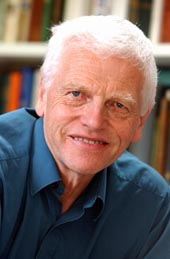
I was born at home, a suburban semi in Whitton, Middlesex, in 1936, “with instruments”, as my mother used to say, and it didn’t mean violins playing. In midwife-speak, I was turned down, a salutary experience for a future writer.
Earliest significant memory is a wartime one from 1944: being collected from an air-raid shelter at school and told our home had been destroyed by a V1 Flying Bomb. Miraculously my family escaped — brothers John and Andrew crawled out of the rubble, having survived under a Morrison table-shelter — although our neighbours in the other half of the house were killed.
After the bombing we were billeted with a farmer and his family in the West Country, an episode that influenced Rough Cider, my book about the memories of an evacuee.
Becoming A Nut
In 1945 a huge crowd packed the White City for the first big athletics meeting after the war, when Sydney Wooderson ran against Arne Andersson. My father took me, but we were among the thousands who didn’t get in.
Even so, my interest in athletics was sparked. Later we went to the London Olympic Games. I grew up a fan and cycled to meetings in and around London through the 1950s. But as an athlete I was inept. You’ve heard of the Fosbury Flop. I was a flop before Fosbury was born, which is why I developed into a track “nut” and not a world-beating athlete. Much later, I wrote a bibliography of track and field, an athletics novel and the official history of the Amateur Athletic Association.
No Work At All
After Hampton Grammar School, I went to Reading University to study Fine Art and soon switched to English. My towering achievement at Reading was finding my future wife, Jax (known as Jackie Lewis then). Studying was just a bind for us both and we ended with less than brilliant degrees. When asked for a reference, Prof Gordon gave me a generous one, but added in a personal note, “You will now admit that you did no work at all.” Ah, but he couldn’t get enough crime novels to read and was amused years later when I sent him one.
National Service followed — as a Pilot Officer who piloted nothing and a Flying Officer who didn’t fly. Teaching RAF boy entrants earned me enough to get married and qualified me to teach in FE, first at Thurrock Technical College, then Hammersmith College. In spare evenings and weekends I tried sports writing. Out of it eventually came The Kings of Distance, my first book. A great thrill, especially when World Sports named it Sports Book of the Year.
The Lure Of Money
But how do you follow that? One day in 1969 we spotted an advert for a first crime novel. The prize was £1000. Too tempting to ignore. Encouraged by Jax, I used my knowledge of obscure Victorian athletics, wrote Wobble to Death in under four months. Off-beat, with a catchy title, it won. The book was launched with a 24 hour Wobble for Shelter around Sloane Square. Barbara Windsor started the race and wobbled better than anyone.
Almost by default I was a crime writer. Good thing Jax had read some whodunnits and could advise, because I hadn’t progressed much past the Saint. Didn’t appreciate the honour of being reviewed by John Dickson Carr, Edmund Crispin, Julian Symons and HRF Keating. I knuckled down to learn the tricks of the trade and wrote seven more Victorian crime novels. In 1975, I kissed farewell to teaching and went full time.
Cribb On The Box…
Waxwork, the eighth novel, had a good review in Time magazine, and TV Producer June Wyndham-Davies decided to buy it for Granada. Starring Alan Dobie as Sergeant Cribb and Carol Royle as the woman awaiting execution, it was screened at Christmas, 1979.
Glittering Prizes
Two series followed. All the book were dramatised and six new stories were written by my wife Jax and me just for TV. Our audience rose to 12.5 million in 1981 and Alan Dobie and William Simons (as Constable Thackeray) were nominated for Emmy awards. Click on TV, Film and Radio for more.
…And Goldengirl On Film
After giving up the day job, I went back to what I knew best. Goldengirl, under the pen-name Peter Lear, was about the exploitation of a brilliant runner aiming to win three gold medals at the 1980 Moscow Olympics. It was filmed starring Susan Anton and James Coburn. Shame about the timing: just before the film was released, the Russians marched into Afghanistan and the Americans pulled out of the Olympics. Not many people know about Goldengirl.
Early in my career, Mad Hatter’s Holiday was shortlisted for the Crime Writers’ Association Dagger Awards. The last of the Cribb books, Waxwork, won the 1978 Silver Dagger and in 1982 The False Inspector Dew won the Gold. The Summons (1995) and Bloodhounds (1996) each won a Silver. In 2000, I was awarded the Cartier Diamond Dagger for my career in crime writing and in 2018 the Mystery Writers of America honoured me as their Grand Master. For the full trophy cabinet, click here.
Getting Up To Date
In 1991, I faced the new challenge of writing about a modern policeman. Peter Diamond, in The Last Detective, took to the bookstands and had a gratifying reception, winning the Anthony Award for best mystery of the year in America. Diamond has gone on to more than twenty other novels and a clutch of awards on both sides of the Ocean. More recently Henrietta “Hen” Mallin has been featured, first in a cameo role in The House Sitter, and then centre stage in The Circle and The Headhunters.
Birthday Present!
To mark my 80th birthday in 2016, fellow members of the Detection Club honoured me with a book of short stories, Motives for Murder, each themed in some way to me or my writing, with titles like The False Inspector Lovesey (Andrew Taylor) and Dreaming of Rain and Peter Lovesey (Ann Cleeves). There was even a sonnet from Simon Brett. The book was published by Sphere and presented to me at a dinner at the Dorchester Hotel. I had reached the point in life when friendly organisations start to think it’s time to give the old man a lifetime achievement award or it could be too late. Several came my way and they were topped in 2018, when I was honoured by the Mystery Writers of America as Grand Master.
Fifty Years Behind The Keyboard
In 2020, my US publishers, Soho Press, put on a virtual Golden Anniversary Gala to celebrate my fiftieth year since Wobble to Death, featuring lovely tributes from Cara Black, Lawrence Block, Liza Cody, Jeffery Deaver, Juliet Grames, Bronwen Hruska, Michael Z. Lewin, Louise Penny and Peter Robinson.
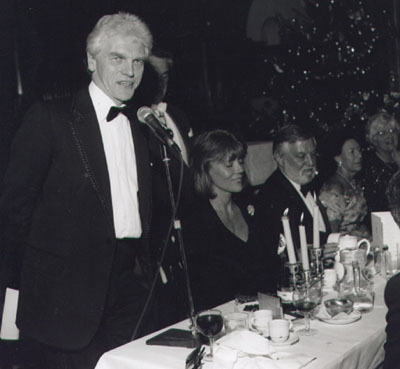 Put On The Spot: In 1990, the CWA had its glitziest Awards Dinner, with Princess Margaret as the main guest, and a galaxy of film and TV stars, among them Diana Rigg, Julie Christie, Francesca Annis and David Suchet. So it was a calamity the evening before when our speaker, John Mortimer, was taken to hospital with a detached retina.
As Vice-Chairman to Catherine Aird, I was asked to fill the breach. I said I’d do it on one condition: that she didn’t add to my stress by seating me next to HRH (that honour went to Catherine herself and James Melville). I spent a nervous night concocting a speech from the comical letters I’d collected. I got by. As Robert Barnard put it, “Peter, as we all know, gets the best postbag since the late Gerard (“There is a French widow in every bedroom”) Hoffnung.”
CWA Awards Dinner: L to R: Peter, Diana Rigg, James Melville, Princess Margaret, Catherine Aird.
